

From Summer Mode to School Mode: Why It’s Not Too Late to Reset Your Child’s Reading Routine
If the end of summer is approaching and you feel like reading time completely evaporated over the last few weeks, take a deep breath. Between balancing work deadlines, organizing summer camps, and trying to enjoy a few sunny family moments, structured routines often take a backseat. That is entirely normal.
Many parents experience a wave of late-summer anxiety, worrying that the lack of formal reading over the break has set their child back. However, you do not need to panic, and you certainly have not missed the window to help your child start the school year with confidence.
The Reality Check: You Are Not Behind
It is easy to feel like everyone else maintained a perfect, daily summer reading schedule, but the data tells a much more reassuring story. Re-establishing a literacy routine is less about playing catch-up and more about activating the brain’s natural adaptability.
What the Research Says:
- Studies on family routines show that up to 70% of households experience a complete drop in formal schedules during school breaks. You are in the vast majority, not the exception.
- Research on learning recovery indicates that even brief, consistent literacy habits introduced just two to three weeks before school starts are sufficient to reactivate core reading skills.
- Short, highly engaging daily reading sessions yield higher comprehension retention than long, forced study periods, meaning you do not need hours of prep to see real progress.
The goal for the remaining days of summer is not to cram a semester’s worth of books into a single week. Instead, it is about easing your child back into a rhythm that makes reading feel like an exciting part of their day rather than a back-to-school chore.
Three Effective Strategies to Build a Back-to-School Reading Rhythm
Transitioning from the relaxed energy of summer to the structure of the school year requires gentle systems rather than rigid rules. Here are three practical ways to rebuild momentum without the power struggles.
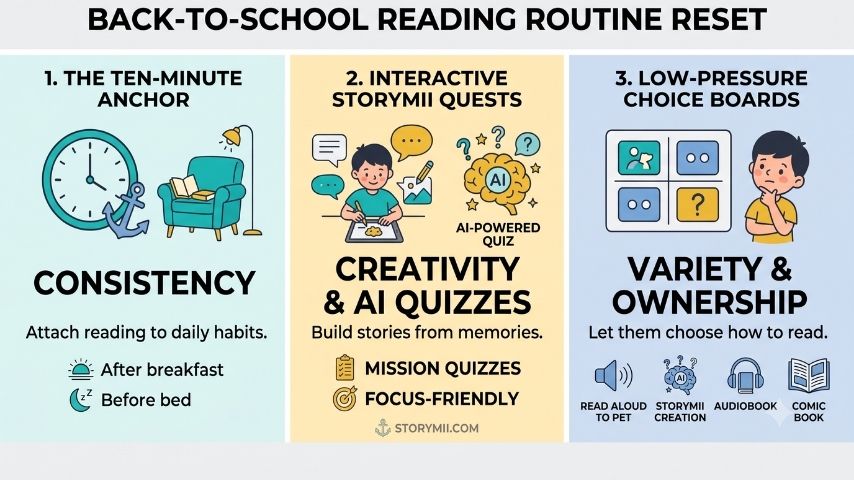
1. The "Ten-Minute Anchor" Habit
Instead of forcing an hour of quiet reading time right out of the gate, attach a quick ten-minute reading window to an existing daily habit. This is known as habit stacking.
Pairing ten minutes of reading directly after breakfast or right after evening bath time creates an easy, predictable anchor. Because the timeframe is short, resistance stays low. Over a week, those ten daily minutes accumulate into over an hour of focused literacy practice, rebuilding stamina without overwhelming your child.
2. Interactive "Reading Quests" with StoryMii
When kids feel that reading is being forced as back-to-school preparation, they often resist. Replacing passive reading with active participation changes the dynamic entirely.
This is where StoryMii serves as an ideal bridge between summer freedom and school readiness.
- Custom Adventure Creator: Children can build their own custom stories based on their favorite summer memories or their feelings about starting a new grade. When children author their own characters and plots, their intrinsic motivation to read and re-read the text skyrockets.
- AI-Powered Mission Quizzes: After finishing a story, StoryMii offers interactive, AI-generated quizzes designed specifically around that text. This turns the reading session into a playful "mission" that checks comprehension, sharpens recall skills, and gives kids an immediate sense of accomplishment.
- ADHD-Friendly, Calm Design: StoryMii provides interactive feedback without resorting to hyper-stimulating animations or loud digital distractions. It keeps the focus squarely on the narrative, protecting your child's attention span as they transition back to classroom-style focus.
3. Low-Pressure "Choice Boards"
Autonomy is one of the strongest drivers of engagement for children. Create a simple, visual "Choice Board" on the fridge with four or five different literacy options for the day.
Let your child choose how they want to fulfill their daily reading time. Options can include reading aloud to a pet, listening to an audiobook chapter during a car ride, creating a story on StoryMii, or reading a comic book. Giving them ownership over the how eliminates the friction of being told what to do.
The Takeaway
You do not need to overhaul your entire household schedule overnight to get your child school-ready. By introducing small, manageable habits and using engaging tools like StoryMii, you can reignite their curiosity and set them up for a confident, successful school year ahead.
Ready to give your child a head start? Visit StoryMii.com to start creating custom stories today.
📚 References & Cited ResearchDeterding, S., et al. (2011).
- Deterding, S., et al. (2011). From Game Design Elements to Gamefulness: Defining "Gamification". Proceedings of MindTrek Conference.
- Howard-Jones, P. (2014). Neuroscience and Education: Myths and Messages. Nature Reviews Neuroscience.
- Karpicke, J. D., & Blunt, J. R. (2011). Retrieval Practice Produces More Learning than Elaborative Studying with Concept Mapping. Science.
- Csikszentmihalyi, M. (1990). Flow: The Psychology of Optimal Experience. Harper & Row.
- Hamari, J., et al. (2014). Does Gamification Work? A Literature Review of Empirical Studies on Gamification. Hawaii International Conference on System Sciences.