Level Up or Game Over? The Invisible Battle for Your Child’s Brain 🎮🧠
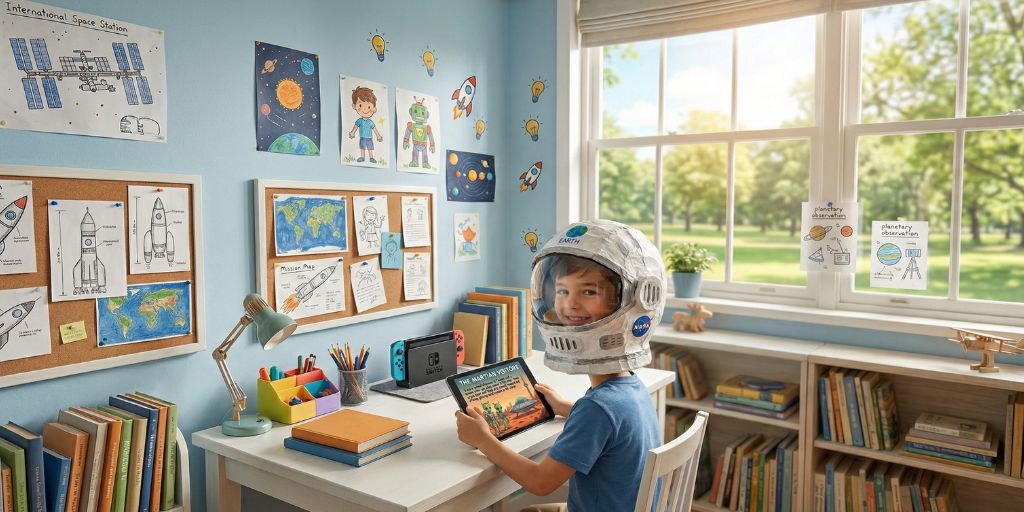
If you're a parent today, this scene is likely on repeat in your home: It’s evening, and the quiet click-click of game controllers or tablet tapping is the only sound. You say, "Okay, thirty minutes is up. Time to read."
What follows isn't exactly a peaceful transition. Usually, it involves a heavy sigh, a slumped posture, or a plea for "just one more level." When the book finally does open, the enthusiasm just isn't there. You see them flipping pages with glazed eyes, clearly wishing they were back in a digital world where everything is vibrant, moving, and constantly rewarding.
The Problem: Why Books Feel "Slow" to a Digital Generation
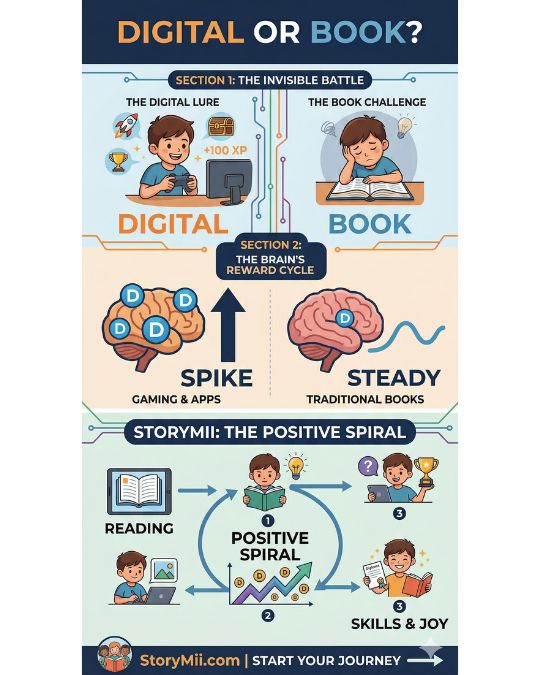
It isn’t that our kids are lazy or that they’ve lost the ability to imagine. The reality is that their brains are being conditioned by high-intensity digital environments. When a child plays a video game or scrolls through a social feed, they receive constant feedback. Every jump, every "like," and every level cleared sends a tiny pulse of satisfaction to the brain.
This surge of "feel-good" neurotransmitters is a powerful motivator. However, when it is generated on-demand by highly stimulating apps, it creates a unique challenge for a still-developing brain.
The Neurobiological Risk:The developing brain is extremely sensitive to dopamine, the key chemical behind our reward and motivation systems. When a child is constantly exposed to the instant gratification of video games (which are designed to deliver frequent, artificial "dopamine hits"), the threshold for what feels rewarding can shift. Over time, activities that do not offer that same immediate feedback, such as reading, start to feel tedious. This continuous high-stimulation environment can actually alter the neural reward circuitry. This makes it difficult for the child to maintain "slow-burn" focus on tasks that require patience, sustained effort, or reflective thought.
Compared to modern apps, a static page of black text on white paper can feel incredibly slow. Reading requires a level of focused, self-initiated effort that struggles to compete with the automated, high-velocity rewards of digital media. Kids often find reading unexciting because it lacks the interactive feedback loop they’ve grown accustomed to. They feel like passive observers rather than active participants in the story.
The Proof: Gamification Increases Comprehension
The good news is that we don’t have to fight technology. We can use the mechanics of what makes games so engaging to actually help them read. This is known as gamification.
- Increased Motivation: Game elements like points, levels, and progress bars directly trigger the production of dopamine. This encourages children to persevere through difficult texts.
- Active Learning: Gamification encourages active recall through features like interactive quizzes that require children to retrieve information. This is a critical step for memory retention.
- Longer Focus: Studies show that gamified learning environments can significantly increase "time on task". This keeps children in a "flow state" longer, which is the mental zone where the most effective learning happens.
The Solution: StoryMii — The "Game" That’s Actually a Book
This is where StoryMii changes the narrative. We’ve built a platform that bridges the gap between the excitement of a video game and the deep benefits of literacy. We use technology for positive developments, creating a "positive developmental spiral."
Most kids' reviews online even call it a "game."
A Calm, Non-Dopamine Inducing Interface
While we use game mechanics, we are very intentional about the "how." Many apps that gamify learning resort to flashing lights and frantic animations to trigger artificial dopamine hits that keep kids addicted. StoryMii uses a calm, ADHD-friendly design. Our interface is clean and focused. This ensures that the excitement comes from the story and the achievement, not from overstimulating digital tricks.
Interactive Challenges and Quizzes
Every story on StoryMii can be turned into a mission. After reading, kids can take AI-powered quizzes based specifically on the story they just read or created. This provides that crucial feedback loop. They are not just reading a book; they are earning points and "mastering" the material.
Creating Their Own Adventures
The ultimate engagement comes from agency. On StoryMii, kids can create their own custom stories, choosing the characters and the plot. This turns them from a reader into a "game designer." When they see their own ideas come to life on the screen, the motivation to read and re-read their creation becomes a natural part of the fun.
The Takeaway
We don't need to ban the joy of gaming to raise a reader. By choosing tools that respect a child's developing brain while providing the interactive feedback they love, we can make literacy the highlight of their day.
Ready to turn reading time into game time? Visit StoryMii.com to start your journey today.
📚 References & Cited Research
- Chambers, R. A., et al. (2003). Developmental Neurocircuitry of Motivation in Adolescence. American Journal of Psychiatry.
- Galvan, A. (2010). Adolescent Development of the Reward System. Frontiers in Human Neuroscience.
- Koepp, M. J., et al. (1998). Evidence for Striatal Dopamine Release During a Video Game. Nature.
- Gentile, D. A., et al. (2011). Pathological Video Game Use Among Youths. Pediatrics.
- Small, G. W., & Vorgan, G. (2008). iBrain: Surviving the Technological Alteration of the Modern Mind. HarperCollins.
- Deterding, S., et al. (2011). From Game Design Elements to Gamefulness. Proceedings of MindTrek Conference.
- Howard-Jones, P. (2014). Neuroscience and Education: Myths and Messages. Nature Reviews Neuroscience.
- Karpicke, J. D., & Blunt, J. R. (2011). Retrieval Practice Produces More Learning than Elaborative Studying. Science.
- Csikszentmihalyi, M. (1990). Flow: The Psychology of Optimal Experience. Harper & Row.
- Hamari, J., et al. (2014). Does Gamification Work? A Literature Review. Hawaii International Conference on System Sciences.
Would you like me to create the "Healthy Engagement" infographic to visually highlight the neurobiological differences for your readers?