

🎄 Keep the Spark Alive: How to Motivate Kids During the Christmas Break (Without Pressure)
Christmas break is magical.
It is also long.
Routines disappear. Bedtimes drift. Motivation drops.
Somewhere between the third movie marathon and the fifth snack request, many parents start to wonder:
How do I keep my child engaged, curious, and learning without turning the holidays into school at home?
At StoryMii, we believe the answer is not more structure or more rules.
It is meaningful engagement, emotional connection, and the right kind of creative momentum.
Let’s look at how to support motivation during the Christmas break without guilt, power struggles, or burnout.
🧠 What’s Really Happening During School Breaks
During long breaks, children are not losing motivation.
Their brains are simply shifting modes.
Research from the Harvard Center on the Developing Child shows that motivation, focus, and emotional regulation rely heavily on routine, predictability, and executive function skills. All of these are still developing in children.
When structure suddenly disappears, kids often show it through:
- Low initiation (“I don’t know what to do”)
- Increased screen seeking
- Irritability or emotional swings
- Avoidance of effortful tasks
This is not laziness.
It is a nervous system recalibrating.
The key is not to recreate school. It is to offer light scaffolding that feels like play, choice, and autonomy.
💬 Motivation Grows From Meaning, Not Pressure
Psychologists consistently find that children are more motivated when activities feel:
- Self-directed
- Emotionally relevant
- Low stakes
- Connected to identity or imagination
That is why Christmas break is actually a perfect time for creativity-based learning, especially storytelling, role play, and imaginative exploration.
When kids feel ownership, motivation follows.
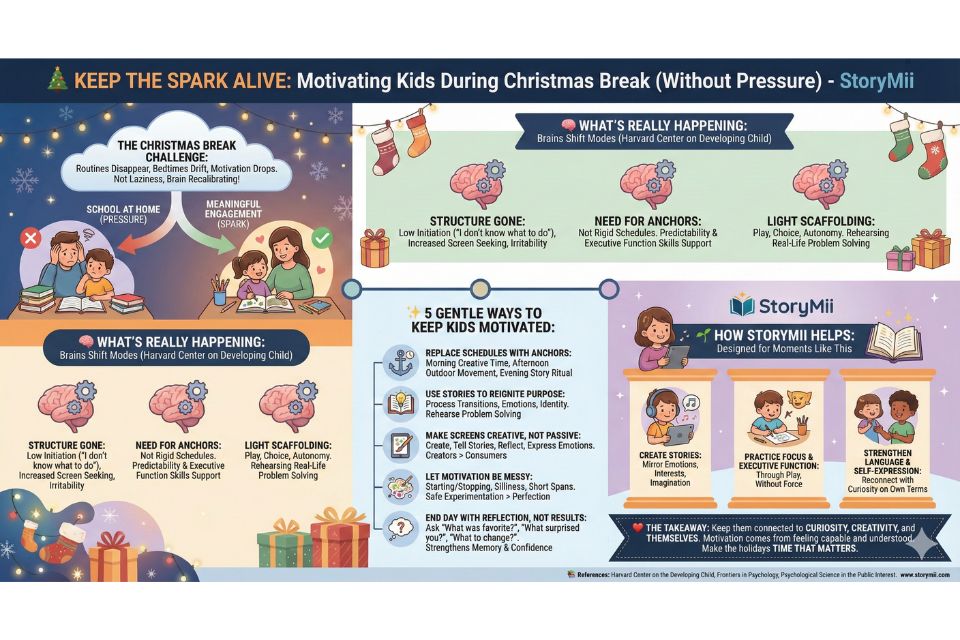
✨ 5 Gentle Ways to Keep Kids Motivated Over the Holidays
These approaches support learning, focus, and confidence without turning your home into a classroom.
1. Replace Schedules With Anchors
Instead of a full daily schedule, choose one or two predictable anchors:
- Morning creative time
- Afternoon outdoor movement
- Evening storytelling or reading ritual
Anchors give the brain stability without rigidity. They support executive function while preserving holiday freedom.
2. Use Stories to Reignite Purpose
Stories help children process transitions, emotions, and identity, especially during breaks.
When kids create stories about:
- A character who feels bored
- Someone who loses motivation and finds it again
- A holiday adventure gone wrong
They are rehearsing real-life problem solving in a safe, playful way.
This is why storytelling is such a powerful motivator. It feels like play, but it builds focus, language, and emotional insight.
3. Make Screens Creative, Not Passive
Not all screen time is equal.
Research published in Frontiers in Psychology shows that creative, story-based digital tools improve motivation and memory compared to passive consumption.
Look for tech that invites kids to:
- Make something
- Tell a story
- Reflect or choose outcomes
- Express emotions
When children are creators rather than consumers, their engagement lasts longer and feels better.
4. Let Motivation Be Messy
Holiday motivation does not look like productivity.
It looks like:
- Starting, stopping, and restarting
- Mixing imagination with silliness
- Big ideas with short attention spans
This is normal and healthy.
Motivation grows through safe experimentation, not perfection.
5. End the Day With Reflection, Not Results
Instead of asking,
“What did you accomplish today?”
Try:
- “What part was your favorite?”
- “What surprised you?”
- “What would you change next time?”
Reflection strengthens memory, confidence, and intrinsic motivation without pressure.
🌱 How Storytelling Platforms Like StoryMii Help
StoryMii is designed for moments exactly like the Christmas break.
By letting children create stories that mirror their emotions, interests, and imagination, they:
- Practice focus without force
- Build executive function through play
- Strengthen language and self-expression
- Reconnect with curiosity on their own terms
A single story session can spark:
- 30 to 60 minutes of engaged focus
- Follow-up drawing, acting, or discussion
- A sense of accomplishment without stress
That kind of motivation lasts beyond the screen.
❤️ The Takeaway
You do not need to keep kids on track during the Christmas break.
You need to keep them connected to curiosity, creativity, and themselves.
Motivation does not come from pushing harder.
It comes from feeling capable, curious, and understood.
When we give children tools to express themselves through stories, imagination, and gentle structure, the holidays become more than time off.
They become time that matters.
📚 References
Harvard Center on the Developing Child
Executive Function and Self-Regulation. 2023.
https://developingchild.harvard.edu/science/key-concepts/executive-function/
Neumann, M. M., & Neumann, D. L.
Touchscreen Tablets and Literacy Development: A Review. Frontiers in Psychology, 2020.
https://www.frontiersin.org/articles/10.3389/fpsyg.2020.00760/full
Hirsh-Pasek, K., et al.
Putting Education in “Educational” Apps. Psychological Science in the Public Interest, 2015.
https://journals.sagepub.com/doi/10.1177/1529100615569721
Center on the Developing Child
Serve and Return Interaction Shapes Brain Architecture. 2017.
https://developingchild.harvard.edu/science/key-concepts/serve-and-return/