
From Frustration to Focus: Why Traditional Reading Fails the ADHD Brain (And How We’re Changing the Story)
If you have a child with ADHD, you know that "reading time" can often feel like "battle time." You see the fidgeting, the glazed-over eyes, and the genuine frustration when they’ve read the same paragraph four times without processing a single word.
As parents ourselves, we lived this. StoryMii wasn’t born in a corporate boardroom; it was born at a kitchen table. We watched our own children—bright, imaginative, and curious—fall behind because the "slow-burn" nature of traditional books couldn't compete with the way their brains were wired.
We realized that to help them, we didn't need to change their brains—we needed to change the book.
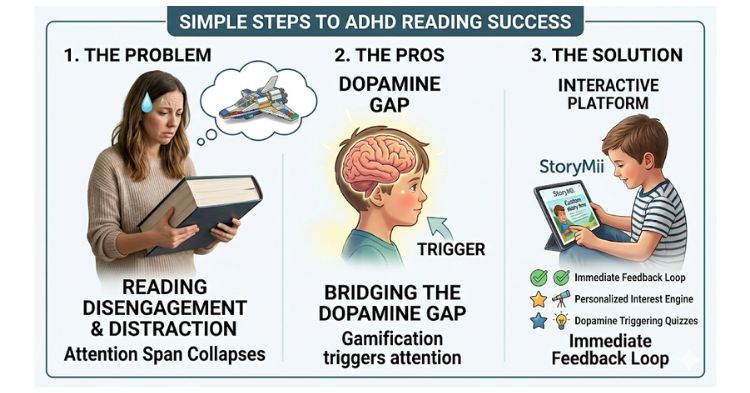
The Problem: The ADHD "Stimulation Gap"
To understand why a child with ADHD struggles to read, we have to look at the Dopamine Reward System. Research shows that the ADHD brain typically has lower levels of baseline dopamine or lower sensitivity to it.
- The Science of "The Slow-Burn": Standard reading is a low-stimulation activity. It requires "effortful processing." For a neurotypical brain, the internal reward of finishing a chapter is often enough to keep them going.
- The ADHD Reality: For a child with ADHD, the brain is constantly seeking a "stimulation floor" just to stay engaged. When a task doesn't provide immediate feedback or high sensory input, the brain effectively "switches off" or seeks stimulation elsewhere (fidgeting, distraction, or daydreaming).
- Executive Function Overload: Reading requires a "symphony" of skills: decoding, working memory, and sustained attention. When one part of the symphony—attention—is under-stimulated, the whole system collapses into frustration.
The Proof: Gamification as a Cognitive Bridge
We didn't just want to make reading "fun"; we wanted to make it accessible. Studies in Neuroscience and Education show that gamified elements can act as a "prosthetic" for executive function.
By introducing Immediate Feedback Loops—the same mechanics that make video games so engaging—we can trigger the dopamine release necessary to sustain focus. When a child sees a progress bar move or earns a badge for completing a page, the brain receives a "micro-reward" that bridges the gap to the next paragraph.
The Solution: A Story for Every Stage of ADHD Development
At StoryMii, we worked with educational experts and neuroscientists to ensure our platform wasn't just "digital reading," but specialized reading. We discovered that ADHD needs aren't a monolith; they evolve as the brain matures. A 3-year-old with ADHD needs different stimuli than a 12-year-old.
How StoryMii Adapts to the ADHD Timeline:
Age Group | ADHD Cognitive Need | StoryMii Feature Solution
Early Years (3–5) | Sensory Regulation | High-contrast visuals and interactive "touch-to-hear" elements to keep tiny hands busy while ears listen.
Primary (6–9) | Working Memory Support | AI-generated "Micro-Missions." Stories are broken into bite-sized "levels" with frequent checks for understanding to prevent cognitive overload.
Pre-Teen (10–12) | Agency & Interest | This age group often resists "prescribed" learning. StoryMii allows them to use AI to co-create the plot, ensuring the content is hyper-relevant to their specific "hyper-fixations."
The "Interest Engine": Our StoryMii Backbone
The breakthrough of StoryMii lies in our patented machine learning technology. We know that an ADHD brain lights up when it encounters a "high-interest" topic—whether that’s space travel, dinosaurs, or a specific K-pop group. When a child is reading about something they love, the "impossible hill" of literacy becomes a flat path.
Our AI doesn't just deliver content; it learns from your child.
- Continuous Engagement: Our backbone tracks how your child interacts with each story. Does their focus dip during long descriptions? Does it peak during dialogue?
- Evolving Complexity: The AI adjusts the narrative flow and vocabulary in real-time. If your child is excelling, the challenge increases; if they are hitting a wall, the AI simplifies the structure to maintain momentum and confidence.
- Predictive Interest: Over time, StoryMii begins to understand the specific themes that trigger your child's "flow state," ensuring that every new story is more engaging than the last.
Designed by Experts, Preferred by Kids
The most important "science" we used was the feedback from the kids themselves. We found that ADHD children preferred StoryMii's calm, clean, ADHD-friendly interface over the "cluttered" designs of other educational apps. Too much "bling" and flashing lights can lead to overstimulation; StoryMii provides a "Zen-like" focus where the story is the star.
We created StoryMii so that our kids—and yours—could move from "I can't" to "just one more chapter."
Ready to see your child excel?
[Visit StoryMii.com to start your journey today.]
References
- Volkow, N. D., et al. (2009). Evaluating Dopamine Reward Pathway in ADHD. JAMA.
- Barkley, R. A. (2012). Executive Functions: What They Are, How They Work, and Why They Evolved. Guilford Press.
- Dovis, S., et al. (2012). Can Motivation Improve Executive Functioning in Children with ADHD? PLOS ONE.